What a medical practice actually needs cleaned daily, weekly, monthly and quarterly - and the tasks that stay with your clinical staff, not the cleaning contractor.
Most medical cleaning checklists you find online are a list of rooms. That is the wrong axis. A practice manager does not need telling that exam rooms get cleaned - they need to know what happens every single night, what can wait a week, and what nobody has touched in a year.
So here is the checklist organised by frequency instead. It separates what a cleaning contractor owns from what stays with your clinical staff, because confusing those two is where most practices get into trouble. Environmental surfaces are one link in the chain the Georgia Department of Public Health tracks when it reports healthcare-associated infections, which is reason enough to get the boring parts right.
Two rules that decide whether any of this works
Clean before you disinfect. Disinfectant applied to a soiled surface mostly disinfects the soil. Detergent and friction first, disinfectant second - it is the order every disinfectant label assumes, and skipping it is the most common failure in medical cleaning.
Contact time is not negotiable. Every EPA-registered disinfectant states how long the surface has to stay visibly wet - usually somewhere between one and ten minutes. Spray and immediately wipe, and you have used an expensive cleaner rather than a disinfectant. If a cleaner is in and out of an exam room in ninety seconds, the dwell time did not happen. This is the whole basis of a proper disinfection service.
Daily
Every night the practice has seen patients. None of this is optional in clinical space.
- High-touch points disinfected: door handles and push plates, light switches, handrails, the reception counter edge, pens and clipboards, the card terminal, the check-in tablet
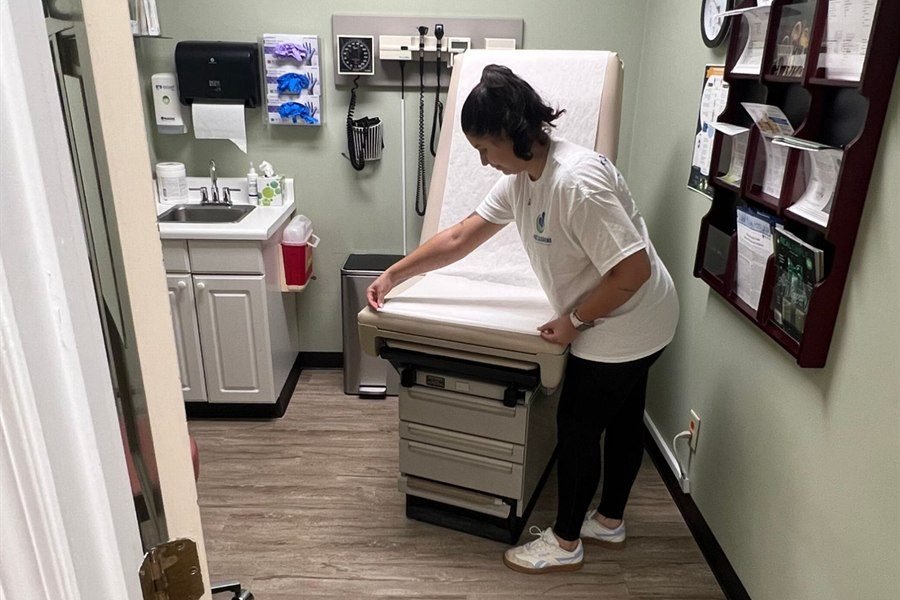
- Exam room hard surfaces: table base and frame, side tables, stools, counters, cabinet pulls, equipment trolleys
- Waiting room chair arms - the most-touched surface in the building and the one most often skipped
- Restrooms: fixtures, flush handles, taps, dispensers, floors, and the inside of the door
- All waste removed including exam room bins, liners replaced
- Floors vacuumed, hard floors mopped with fresh solution per area - not one bucket for the whole building
- Entry and reception glass
- Break room surfaces, sink and fridge exterior
Weekly
- Detail vacuum carpet edges and under reception furniture
- Damp wipe baseboards, door frames and chair legs
- Backs and undersides of waiting room seating
- Glass partitions and sneeze guards cleaned in full, not just at eye level
- Grout scrubbed at restroom fixtures
- Phone handsets, keyboards and mice disinfected at every workstation
- Vents and returns checked and dusted where reachable
Monthly
- High dusting: cabinet tops, light fittings, ceiling vents, wall-mounted equipment
- Walls wiped at hand height through corridors and exam rooms
- Interior windows and sills
- Waiting room upholstery spot-cleaned and refreshed
- Under and behind reception desks and storage units
- Break room and restroom floors scrubbed and recoated where the finish allows
Quarterly and annual
- Carpet hot-water extraction in waiting areas and corridors - quarterly in a busy practice, twice a year at an absolute minimum (commercial carpet cleaning)
- Full tile and grout restoration in restrooms and wet areas
- Hard floors stripped and refinished
- Upholstery deep clean on all waiting room seating
- Light fitting covers removed and washed
- Scope reviewed with your contractor - rooms change use, and a scope written two years ago is usually wrong
What stays your staff's job, not the cleaner's
This is the part that matters most, and a cleaning company should tell you plainly rather than let you assume.
- Between-patient exam room turnover. That happens during clinic hours, by clinical staff, to your own infection control protocol. No evening contractor can do it.
- Sharps. Containers are placed, handled and replaced by your staff. A cleaner should never handle one beyond reporting that it is full.
- Regulated medical waste. Red bag waste goes through your licensed medical waste contractor. A general cleaning crew removes general waste only.
- Anything inside the sterilisation workflow. Instrument processing, autoclave areas and clean/dirty zoning stay clinical.
- Blood and other potentially infectious material spilled during hours. Your OSHA bloodborne pathogens exposure control plan governs that, and your trained staff carry it out.
A contractor who offers to take all of that on is either misunderstanding the rules or hoping you do not know them.
What it costs in metro Atlanta
Medical space prices higher than general office because it genuinely takes longer per square foot - more disinfection, more dwell time, more care around equipment. From our published rates:
- 1,500 sq ft, one restroom, weekly - about $96 a visit, roughly $382 to $466 a month
- 2,500 sq ft, two restrooms, weekly - about $153 a visit, roughly $608 to $740 a month
- 3,000 sq ft, two restrooms, three nights a week - about $157 a visit, roughly $1,874 to $2,281 a month
- 5,000 sq ft, four restrooms, five nights a week - about $223 a visit, roughly $4,447 to $5,414 a month
Run your own numbers on the pricing page, or see what a full medical office cleaning scope covers.
If you would rather have the room-by-room version than the frequency version, our guide to what a medical clean should include walks through reception, exam rooms, labs and staff areas in turn. For the wider commercial picture see commercial cleaning and janitorial programs, or book a free walkthrough.
Common questions
How often should a medical office be cleaned?
Daily for any practice seeing patients five days a week - the daily list above is not optional in clinical space. Three nights a week can work for a low-volume specialist practice seeing a handful of patients a day. Below that you are relying on staff to absorb the gap, and they will not.
Can you clean during patient hours?
We would rather not. Evening work keeps equipment, chemicals and crews out of clinical space while patients are present, which is both safer and easier to defend at inspection. Daytime emergency clean-ups are a separate conversation.
Do your cleaners handle medical waste?
No - general waste only. Regulated medical waste and sharps stay with your licensed waste contractor and your clinical staff, for the reasons set out above.
What certifications should a medical cleaning contractor have?
Bloodborne pathogens training at absolute minimum. Ours hold seven IJCSA certifications including Medical Cleaning Service Provider, Bloodborne Pathogens and Infectious Disease, Chemical Hazards, and Biohazard Cleaning with OSHA 40-hour HAZWOPER training. Ask any contractor for the certificates themselves, not the claim.
Which areas do you cover?
Medical practices across 28 metro Atlanta cities, including Sandy Springs, Dunwoody, Brookhaven, Marietta and Decatur. The full list is on the service areas page.